Interactive keyboard
12-tone equal temperamentB Major
Selected notes: B – D♯ – F♯
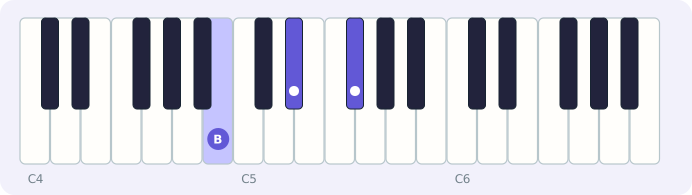
The B chord is built from B – D♯ – F♯. See the exact keys, hear how they sound together, and explore how the chord changes when you move its lowest note.
Selected notes: B – D♯ – F♯
All inversions use the same pitch classes. Moving the bottom note up an octave changes the voicing, not the chord identity.
Lowest note: B. Each higher note is placed above the previous one.
Lowest note: D♯. Each higher note is placed above the previous one.
Lowest note: F♯. Each higher note is placed above the previous one.
First, find B, the root of this chord. Then add D♯, the major third. Add F♯ to complete the triad.
Play the notes together to hear the harmony, or one at a time to hear how the intervals form the chord. Start at a comfortable octave; the diagram shows one reference voicing, not the only valid place to play it.
B major is a useful introduction to sharp note spellings. Its written notes are B–D♯–F♯, with both upper chord tones on black keys.
Compare B major to B minor (B–D–F♯). The only difference is whether the third is D♯ or D natural.
Hold B and F♯, alternate D and D♯ in the middle, and hear how one semitone changes the overall harmony.
Avoid writing E♭ in place of D♯ in this B major chord: they sound alike on the piano but have different scale-degree names.
Finger numbers depend on your hand size, octave and musical context; there isn't one universally correct fingering for every voicing.