Interactive keyboard
12-tone equal temperamentE♭ Major
Selected notes: E♭ – G – B♭
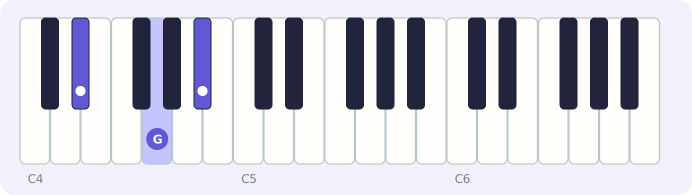
The E♭ chord is built from E♭ – G – B♭. See the exact keys, hear how they sound together, and explore how the chord changes when you move its lowest note.
Selected notes: E♭ – G – B♭
All inversions use the same pitch classes. Moving the bottom note up an octave changes the voicing, not the chord identity.
Lowest note: E♭. Each higher note is placed above the previous one.
Lowest note: G. Each higher note is placed above the previous one.
Lowest note: B♭. Each higher note is placed above the previous one.
First, find E♭, the root of this chord. Then add G, the major third. Add B♭ to complete the triad.
Play the notes together to hear the harmony, or one at a time to hear how the intervals form the chord. Start at a comfortable octave; the diagram shows one reference voicing, not the only valid place to play it.
E♭ major is spelled E♭–G–B♭. It is often easier to remember by finding G first and locating the two nearby black keys.
C minor (C–E♭–G) shares E♭ and G with E♭ major. The B♭ of E♭ major can move to C for a smooth change.
Play E♭–G–B♭, then change to C–E♭–G. Hear the shared E♭ and G while the bass moves.
Use E♭ and B♭ in the note names; calling them D♯ and A♯ would hide the stacked-third structure.
Finger numbers depend on your hand size, octave and musical context; there isn't one universally correct fingering for every voicing.